Quick Answer
Yes. Eating and drinking on trains is generally allowed in Japan. There is no nationwide rule that simply bans passengers from eating or drinking on trains. For example, JR West explicitly says that eating and drinking on board is permitted, while asking passengers to keep the train clean and avoid inconveniencing others.
However, where and when you eat matters. Eating on a Shinkansen or other long-distance train is generally common, while eating on a crowded commuter train is more likely to inconvenience people around you. JR East specifically asks passengers to be considerate of other passengers when eating on board.
So the practical rule is simple:
Long-distance train or Shinkansen? Eating is usually fine. Crowded commuter train? It is better to wait until you get off.
Is It Illegal to Eat on a Train in Japan?
No. Eating or drinking on a train is not, by itself, generally prohibited by a nationwide Japanese law.
That does not mean that every action involving food is unrestricted. Japanese railway regulations also contain rules concerning conduct and items that may cause problems for other passengers.
For example, JR Central’s Passenger Regulations prohibit passengers from bringing items on board that may cause inconvenience to other passengers because of dirtiness or odor.
This creates an important distinction:
- Eating food on a train: generally allowed
- Items that may significantly inconvenience other passengers: may be restricted under railway rules
- Ordinary inconsiderate behavior: generally a matter of etiquette, although some conduct may also violate railway rules or other laws
In other words, eating a sandwich on a train is not automatically illegal just because you are eating on board.
Is Eating on a Train Considered Rude?
Sometimes—but it depends on the train and the situation.
JR East does not simply tell passengers not to eat. Its official etiquette guidance asks passengers to be considerate of the people around them when eating on the train.
JR West likewise says that passengers may eat and drink on board, while asking them to keep the cabin tidy and avoid inconveniencing other passengers.
So there is no simple rule such as:
“Japanese people never eat on trains.”
That would be misleading.
A useful rule of thumb is:
The more crowded and enclosed the situation is, the more carefully you should consider the people around you.
For example, eating a small snack while seated on a relatively quiet train is very different from opening strongly scented food in a packed commuter train.
When Is Eating on a Train Common in Japan?
Shinkansen
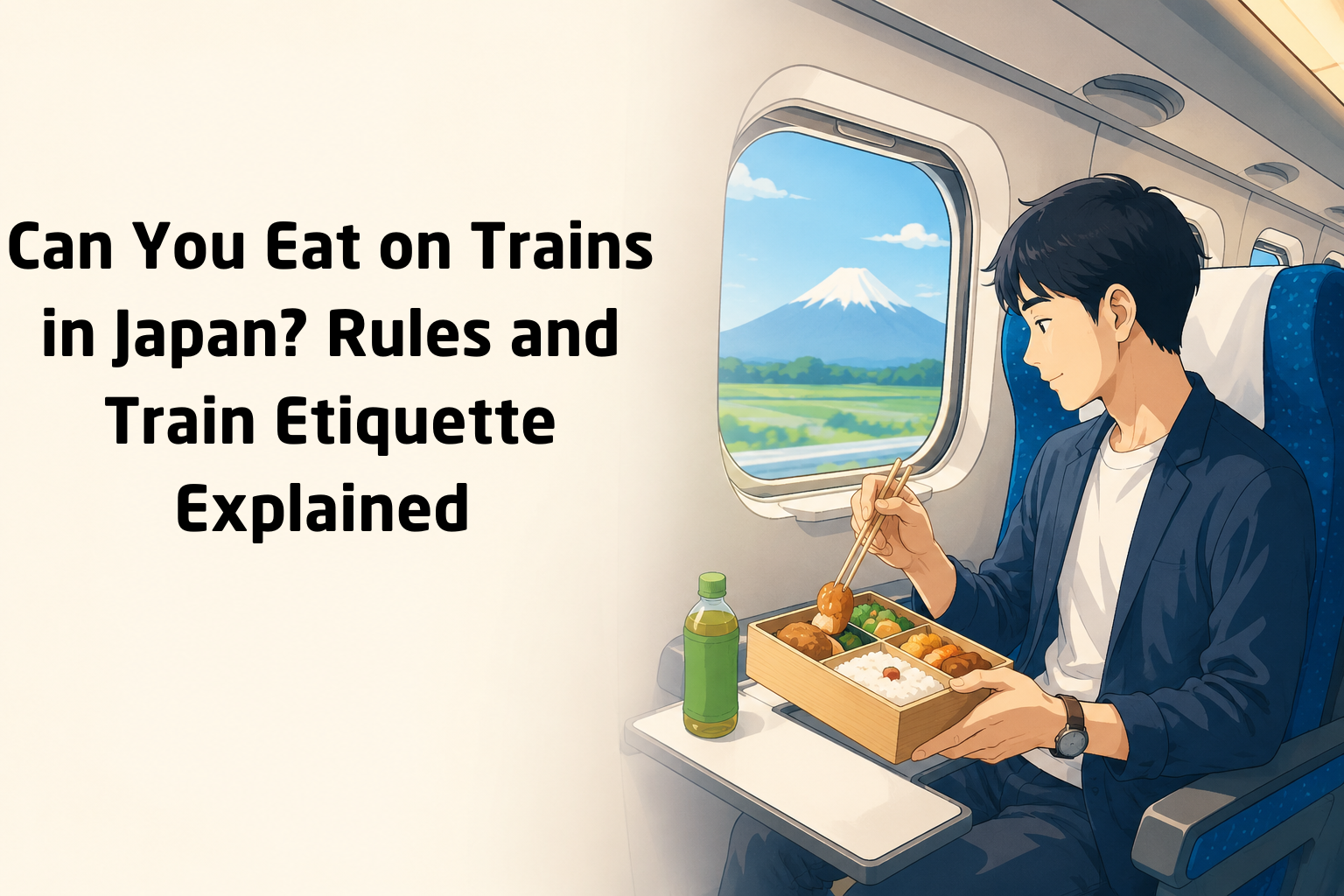
Eating on the Shinkansen is generally normal, especially during longer journeys.
The Japanese railway travel experience is also closely associated with ekiben, or station bento boxes. JR East continues to promote food and bento as part of the train travel experience, including food that can be enjoyed during railway journeys.
So if you buy an ekiben at a station and want to eat it during a Shinkansen journey, you generally do not need to worry that you are breaking a Japanese rule.
You should still keep your seat and the surrounding area clean and be considerate of other passengers.
Limited Express Trains
Eating is also common on many limited express trains, particularly on services where passengers spend a longer time on board.
The exact rules can vary by train and service, so do not assume that every train operates in exactly the same way.
Some special sightseeing trains and other services even offer food as part of the journey. For example, JR East operates train services that allow passengers to enjoy local food during their trip.
Ordinary Commuter Trains
This is where more caution is appropriate.
On ordinary commuter trains, especially when they are crowded, eating can inconvenience people around you. JR East specifically asks passengers to consider other passengers when eating on board.
So if you are on a packed commuter train, waiting until you get off is the simplest choice and is least likely to inconvenience other passengers.
What Should Tourists Do?
You do not need to memorize complicated rules. Use these simple guidelines.
1. On a Shinkansen or Long-Distance Train
Eating is generally fine.
An ekiben, sandwich, snack, or drink is not unusual on a long-distance train.
Keep your seat and the surrounding area clean, and be considerate of passengers nearby. JR West explicitly permits eating and drinking on board while asking passengers to keep the cabin tidy and avoid inconveniencing others.
2. On a Normal Local Train
Look at the situation first.
If the train is relatively quiet and you are seated, a small snack or drink is less likely to inconvenience other passengers.
If the train is crowded, it is better to wait until you get off.
3. Be Considerate With Strong-Smelling Food
This is worth keeping in mind, but there is no need to assume that every strongly scented food is automatically forbidden.
JR Central’s Passenger Regulations state that items that may inconvenience other passengers because of dirtiness or odor cannot be brought onto its trains. JR Central’s own passenger guidance also lists “items that emit odors” among articles that cannot be brought on board.
This is a rule about items that may cause inconvenience, rather than a simple list of foods that passengers are forbidden to eat.
As a practical matter, avoid bringing or eating food that is likely to cause significant discomfort to people sitting close to you, particularly on a crowded train.
4. Clean Up After Yourself
If you eat or drink on a train, do not leave food, packaging, or spills behind.
JR West specifically asks passengers who eat and drink on board to keep the cabin tidy.
Do All Trains Have the Same Rules?
No.
Japan does not have one single rule that covers every train and every railway operator.
Railway companies and individual train services may have their own rules or instructions. Special trains, events, and particular services may also have additional restrictions.
Therefore, if a railway company, train crew member, or a specific service provides instructions, follow them.
The same principle applies to food and other items that could significantly inconvenience other passengers.
Don’t Confuse “Uncommon” With “Illegal”
This is one of the most important things for visitors to understand.
Something can be uncommon or impolite in a particular situation without being illegal.
For example, avoiding a full meal on a packed commuter train is a sensible etiquette choice. That does not mean that eating a sandwich on such a train is automatically illegal.
Conversely, some actions or items can be subject to railway rules even though the issue is not simply “eating is rude.”
The easiest way to think about it is:
Law and railway rules tell you what can be prohibited or restricted. Etiquette helps you decide what is considerate in a particular situation.
JAPAN SURVIVAL TIP
Shinkansen or long-distance train? Eating is usually fine. Crowded commuter train? Wait until you get off if you can.
You do not need to be afraid of making a cultural mistake.
When in doubt, look at the situation around you, keep your food unobtrusive, avoid causing strong odors or mess, and be considerate of the people nearby.
That is usually all you need to know.
Sources
- JR West — Is it OK to eat and drink on board?
JR West explicitly states that eating and drinking on board is permitted, while asking passengers to keep the cabin tidy and avoid inconveniencing other passengers. - JR East — Train Etiquette / Q&A Guide
JR East asks passengers to be considerate of other passengers when eating on the train and provides etiquette guidance for crowded conditions. - JR Central — Passenger Regulations, Article 307
JR Central’s Passenger Regulations prohibit items that may inconvenience other passengers because of dirtiness or odor, among other prohibited items.
Sources last reviewed: August 24, 2026
The Bottom Line
Japan does not have a blanket “no eating on trains” rule.
Eating and drinking are generally allowed, especially on Shinkansen and long-distance services. On crowded commuter trains, however, it is more considerate to wait until you get off.
You do not need to worry about accidentally breaking a law every time you eat on a train. Pay attention to the type of train, the crowding level, the food you are carrying, and the people around you.